It’s no secret that JRPGs have established themselves a prominent position on the Switch offerings, and eShop and retail connoisseurs are no strangers to the remasters and ports that seemingly have no end. In fact, it’s starting to feel like it is the goal of every game developer, big and small, to port literally every game they ever made to Nintendo’s newest machine. But being that JRPGs enjoyed a great deal of popularity in the golden age of gaming, but in many circumstances did not age gracefully, we’re seeing a big resurgence of these massive RPGs, with some new quality of life features.
Like most gamers, personal tastes of mine have changed from my earlier years to my 30s, and my supply of gaming time has tragically been reduced year after year. Lucky for me and other 30-something’s, it seems like the game developers of these games have taken notice, and made it a point to address this concern in the form of special “enhanced remasters” that let you play quicker and remove some general inconveniences from the game.
It’s akin to microwave meals taking over in the 1960s in the name of convenience, just without the preservatives and cancer causing ingredients.
On the surface, it’s sad to think about, as gaming has turned to yet another thing we can’t spend the full, uninterrupted time for which it was intended, but at the same time, optimizing the amount of entertainment you can get in a period of time is a grand idea. After all, the ability to play through genres of games that I’d typically dismiss due to gameplay length is something to be celebrated, if you ask me. Long, arduous tasks like trekking across large areas loaded with constant random encounters can drag a game down and turn me off to playing it entirely.

Hell, random encounters seem like a driving force in these enhanced remasters, with features such as “No Random Encounters” and “Turbo Mode” allowing players to skip through the fluff in order to get to the meat of the game.
Of course, this raising the question: what’s the “microwave dinner” affect on these enhanced remasters? Before I go into that more, I want to talk about one of my favorite games…
Dark Cloud 2
The first time I played a game outside the boundaries of what could be expected by the developers was Dark Cloud 2, a game that quickly shot up into the ranks of my favorite games of all time. A game I have been begging Level-5 to release a sequel for, for years now. Level-5, plz. Plz Level-5.
But anyway, Dark Cloud 2. It is a terrific game that, in it’s ordinary form, was a bit sluggish for my tastes. It’s an action-RPG that, in my opinion, needed to be a few frames per second faster to really max-out the action. “But wait,” you may be thinking, “earlier, you said it’s one of your favorite games of all time!” That I did! But this was probably due to the fact that I played the entire game at 1.18x the base speed. I tried originally playing Dark Cloud 2 through traditional means: my Playstation 2. But it felt far too sluggish, so I ripped the game to my PC and played it through an emulator, cranking the clock speed up and experimenting a bit, ultimately finding a sweet spot at 1.18x.

In other words, if the game ran at 60 frames per second, I was running it at ~71fps. This allowed the game to play exactly the same but with just a tad quicker gameplay. This might not sound like much, but that game took me roughly 60 hours to complete according to the save file. In reality, it took me only 49.2 hours! That’s over 10 hours saved by making a tweak that made the game more fun. The other benefit was that it increased the difficulty so that my attack timing needed to be dialed in, which made me far better at the game in order to succeed, with the “prize” being that the gameplay was simply more fun.
Here – see for yourself. Watch the combat for a bit, then change the video playback speed to 1.25x, close enough to match the experience I had.
Now, there’s an example of unofficially tweaking a game, but what about these “enhanced remasters” I keep talking about? Enter the Final Fantasy franchise. And what better remaster to focus on then the one that started all these “boosters” that are now ubiquitous:
Final Fantasy X|X-2 Remaster
I first played Final Fantasy X on my friend’s Playstation 2 many years ago, and it had lived on my bucket list for ages. I finally grabbed it on a Steam sale where.. it sat for several more years. When I finally got around to playing it, I was stoked to learn that it came with some of these enhancements that they called “game boosters”. Specifically, a “Turbo Mode” which let you crank the game speed by 2x, 4x, etc, and “No Encounters” mode which I mentioned earlier and, you guessed it, removes random encounters entirely.
Those who have read my writings before know I despise random encounters and in most cases, will make me instantly uninstall a game and reformat my hard drive, so this was a godsend. I was going to finally finish this game.
And ultimately, I did! Although it did eventually wear on me, I finished it. For the most part, I left random encounters on, but cranked up the turbo during said encounters. Why lose out on XP, right? Being able to navigate the overworld in 2x speed was great, and it saved me tons of time that let me focus on the fun parts, those being the boss battles, exposition, and exploration.
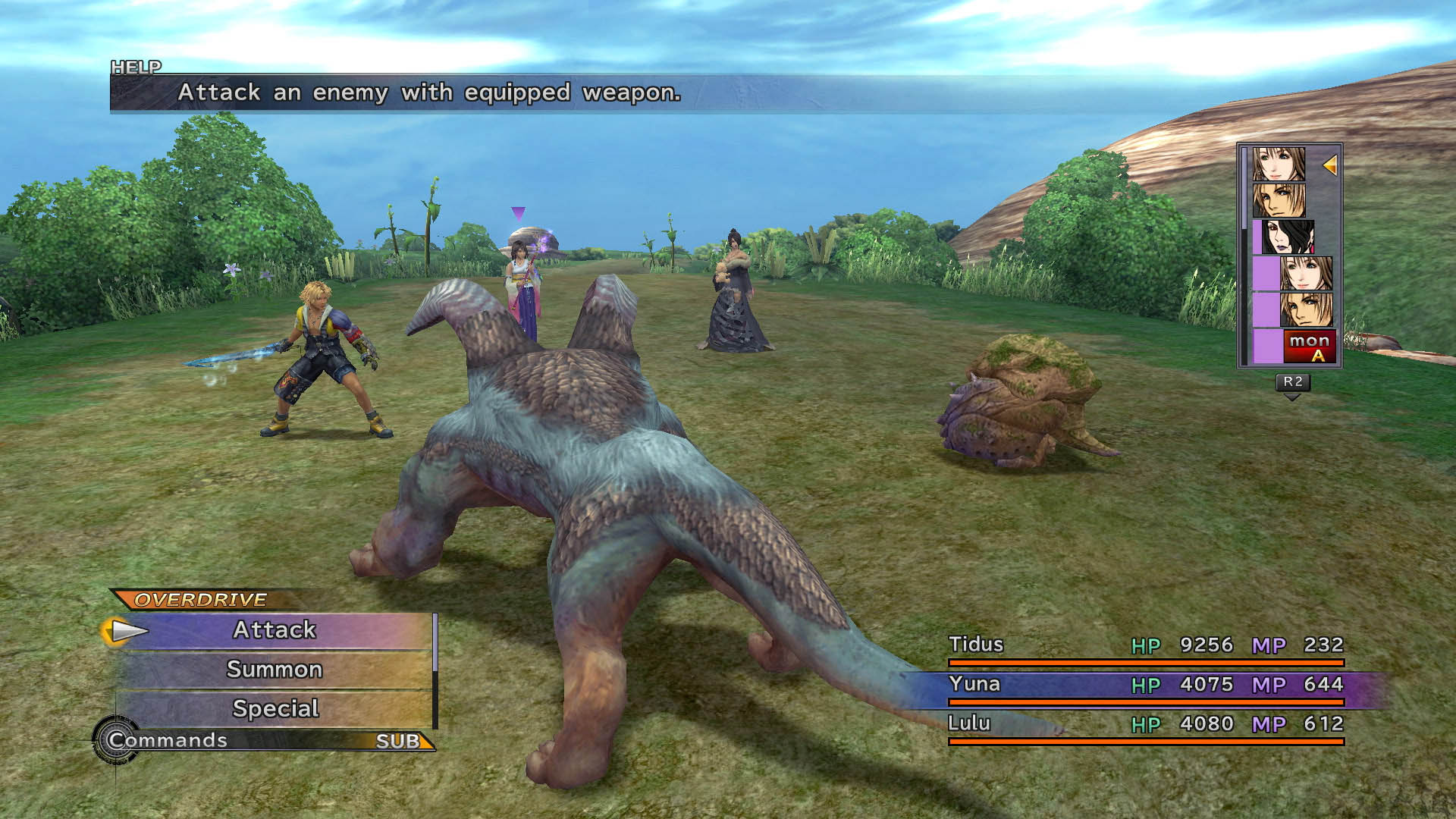
My question I mentioned earlier was – did I break the game by using these boosters? Many might say yes, and I agree that some of the things I did, broke the game. Specifically, I spent some time camping near save points and railing through random encounters at top speed in order to earn more spheres to upgrade my characters. As grinding is a necessary evil in most JRPGs, some might say I didn’t put in the time to beat the bad guys, or whatever.
Now hear me out, but this is where I think the “you didn’t earn your stripes” turns into a fallacy. I think we can agree that the following points about RPGs are factual:
- If your character is under-leveled, an expected behavior is for the player to grind.
- Grinding is, by nature, repetitive, and can take a lot of time, becoming a major portion of the core gameplay time.
That being said, what’s the difference if I spend 5 minutes grinding, or spend an hour grinding, if I get the same result at the end? Might as well save 55 minutes, right? Well, that’s my line of thinking, but I’m curious what others have to say on this topic, and that’s where the comment section comes into play!
Mixed Signals
While doing research for this article, Final Fantasy games were a major focus and in fact a central driving force behind writing this in the first place. Square Enix made it clear that the Final Fantasy remakes coming to Switch would have enhanced editions with all the aforementioned game boosters.
…but with a quick glance on the game remaster site, Square Enix boasts about “Over 100 Hours of Gameplay!”
“Here is a 100 hour game, also, we included a button that’ll make it 50 hours.” What are they trying to say about their own game? And on the subject of gameplay, what is their intended experience?
And while thinking about this, I think I discovered the answer. The player gets to control their own experience.
I feel it can be argued that the very presence of Turbo Mode in a remaster highlights how disrespectful to time games used to be, while also fixing the problem altogether. Otherwise, what would be the point of including them?
All in all, I think the concept of these boosters is that game developers know their core demographics for these games. People like myself without 100 hours to spend on a single game, who might be able to make 50 hours work. They’re great for adults with less time, and for all ages of players that simply don’t want to spend time in their 1,000th random encounter so they can proceed in the game. Times have changed, and it’s great to see the games change, too. Those who enjoy the grind, can grind.
Enhanced remasters are a terrific way to bring back classics with a modernized experience, while giving older players hits of nostalgia and letting them control their experience. Many complain about all the ports, particularly that the Switch has been receiving since… well, since release, but these enhanced versions give far better experiences in most cases.
Heck, I quit playing Final Fantasy XII on my Playstation 2 as soon as I learned about a Switch version coming out with Turbo Mode. I intend on playing the Final Fantasy IX remake at some point this year for the same reason.
All this talk of Final Fantasy really tells you something about the franchise – forcing players to spend hours grinding is no longer acceptable. We get it. But there are plenty of other examples “hacking” RPGs to make them take less time – Pokemon games allowing you to disable battle animations, for instance, has been a feature since forever. Personally I don’t find anything wrong with that. Just the opposite.
I’m curious what folks think about “Turbo Mode” as it becomes almost a requirement in remakes these days. When do built-in hacks improve the game, and when do they go overboard? Leave a comment below!
 nostalgia trigger
I quite liked the fast mode on FFXII on PS4 🙂 It was useful for levelling and traversing large areas of open ground. It’s optional, so you I could still experience it the way it was originally intended if I chose 🙂 I see it as a win-win.
LikeLiked by 1 person
Totally! I can’t wait to try it again with the nice speed improvements. Final Fantasy games are so weird to me, like I love the universe of them, and I want to eventually play them all (minus the original NES ones, just not a fan of that style), but I can’t stand endless exposition, cutscenes, or turn-based battle. Ya know, those three things that FF games are famous for :O
However, these games are all of a sudden far more playable once you add in the ability to hasten things. Nothing is worse to me than games that drag on or that turn into talking simulators, and turbo mode and disabling random encounters basically fixes all of those problems.
LikeLiked by 1 person
Heh heh 🙂 Well the 3 main things about FF imo are story, characters and music. But I see your point 🙂
LikeLiked by 1 person